1920-1939 DEFENSIVE LINES
SUMMARY :
⟩ HISTORICAL INTRODUCTION
⟩ DESCRIPTION OF THE FESTE
⟩ PICTURES
⟩ GERMAN AND FRENCH FORTIFICATIONS 1870-1945
⟩ 1871 A NEW POLITICAL AND STRATEGIC SITUATION
⟩ 1871-1883 THE ERA OF DETACHED FORTS
⟩ 1883 THE BRISANCE SHELL CRISIS
⟩ 1886 REINFORCEMENTS: CONCRETE AND MANY MODIFICATIONS
⟩ 1893 THE ARMOURED FORTIFICATION
⟩ 1897 THE SPEADED FORTIFICATION
⟩ 1914 TRIAL BY FIRE
⟩ 1920-1939 DEFENSIVE LINES
⟩ 1939-1945 THE END OF FORTIFIED SYSTEMS
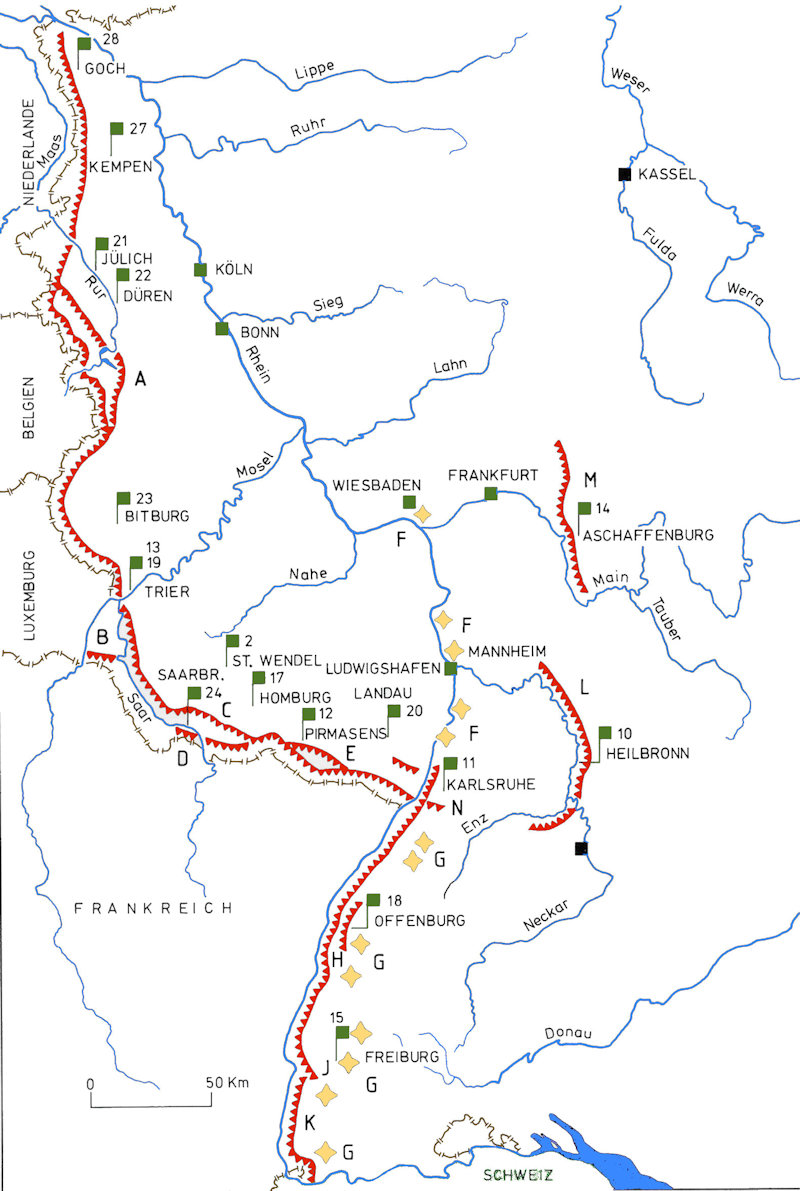
1920-1939 Defensive Lines
The First World War made it clear that permanent fortifications, built in peacetime, eat up considerable budgets and suffer inevitable obsolescence, due to the incessant technical progress produced by industrial societies.
The disastrous Versailles Peace Treaty signed on 28 June 1919 ushered Europe into a new era of political and military tensions. The financial crisis of 1929 dealt a fatal blow to the young German democracy, which was confronted with the dramatic impoverishment of the population and the populist discourse of a new party, the NSDAP. The nationalist and fascist party came to power legally in this context.
In France
France, obsessed with its revenge, occupied the left bank of the Rhine and the coal and iron mines of the Saar. It imposes an almost complete demilitarization of Germany and demands the payment of the indemnities fixed by the treaty, whatever the social situation in Germany. Faced with the fascist danger it was not able to help the young Weimar Republic, it persevered in its desire to destroy German potentialities and prepared for a new war The construction of the Maginot Line in 1928 destroyed any hope of peaceful coexistence between France and Germany.
In Germany
The payment of huge war indemnities, combined with uncontrollable inflation, dramatically impoverished the German population, which clung to the illusory hope of promises from the Nazi Party. The construction of the Maginot Line was obviously not seen as a positive sign by the German public. The death trap of Nazism closed with the appointment of Adolf Hitler as chancellor on 30 January 1933. Remilitarization was definitively enacted by the creation in 1935 of the Wehrmacht to replace the Reichswehr imposed by the Treaty of Versailles.
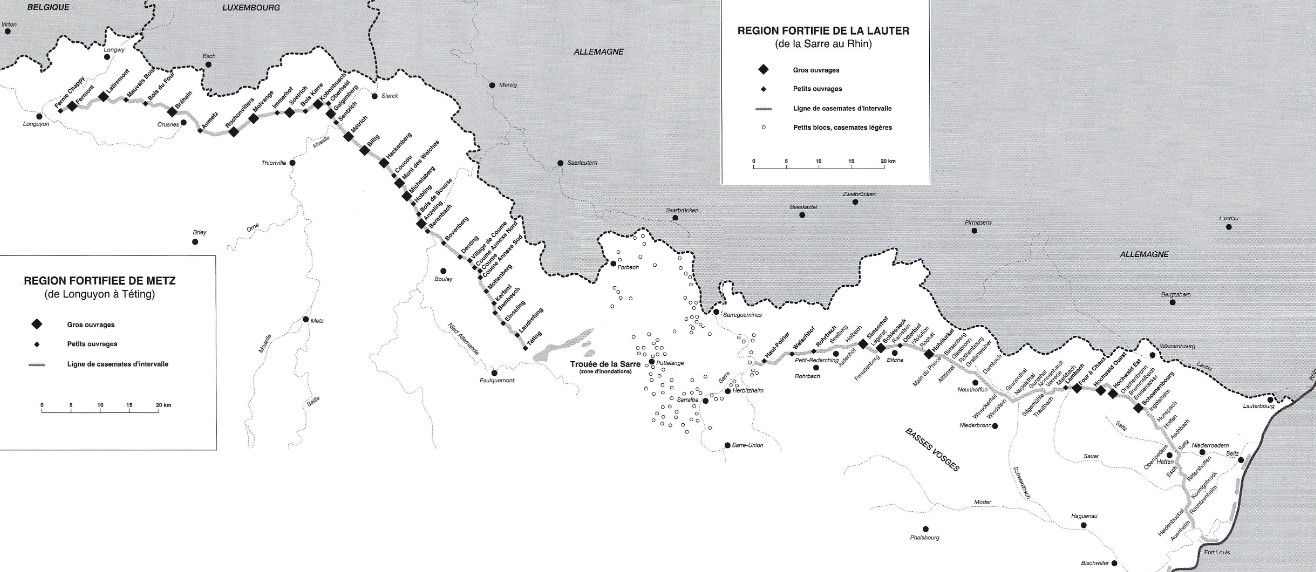
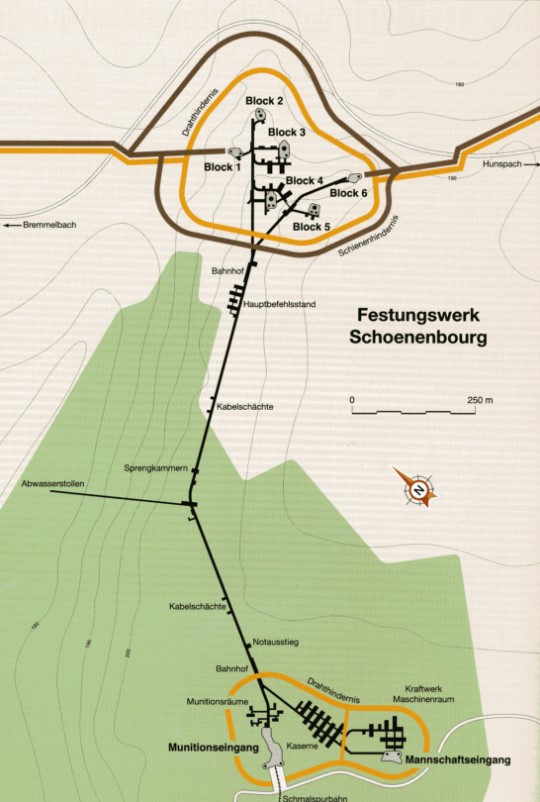
The eastern borders, with Germany and Italy, constituted, as in 1872, the zones of initiation of the future conflict. Following the example of the “Séré de Rivières” defensive lines, the Minister of War, André Maginot, passed budgets to erect defensive lines along these borders. These lines will be made up of independent works, a few kilometres apart in order to enable them to protect each other by the action of their artillery. The Maginot works follow a pattern derived more or less from the fort palmé. The discovery of the German Festes after the armistice of 1918 and the analysis of the sieges of the First World War strongly influenced the engineers who developed the concept of the structures.
The battle blocks are located on the fronts at the level of the defensive line, they are built on two levels: the upper level with the artillery turrets and infantry casemates is connected to the underground level at a depth of 20 to 30 meters by a staircase and an elevator. The blocks are connected by a main gallery a few hundred metres long at the rear where logistics, ammunition stocks, the power plant and the garrison barracks are grouped together. This gallery, equipped with an electric train, constitutes the technical backbone of the structures.
All the premises are equipped with overpressure means for protection against combat gases.
The complexity of the systems embedded in the works will require the formation of specialized fortress troops with a ratio of one gunner for every forty men necessary for the operation of the structure.
The Maginot Line had:
- 142 works
- 352 casemates
- 78 shelters
- 17 observatories
- about 5000 blockhouses
.The Maginot Line cost more than five billion francs from 1930 to 1936.
The enormous construction costs will require many cost-saving measures when drawing up plans and will have an impact on the other needs of the armed forces. Training an entire generation of military personnel on the defensive will also prove to be a major problem. Finally, there is the absence of anti-aircraft assets and the relative weakness of anti-tank means and firing ranges that are too short to keep enemy artillery out of range. The main historical mission of fortifications, which consisted in locking down obligatory crossing points, bridges, crossroads, roads, railway lines, etc., was called into question by the massive development of means of land clearance, aircraft and off-road vehicles. The illusory motto “You don’t pass\ no longer had any substance from the moment it was possible to pass over or miss it.
1936-1937 Oder-Warthe-Bogen
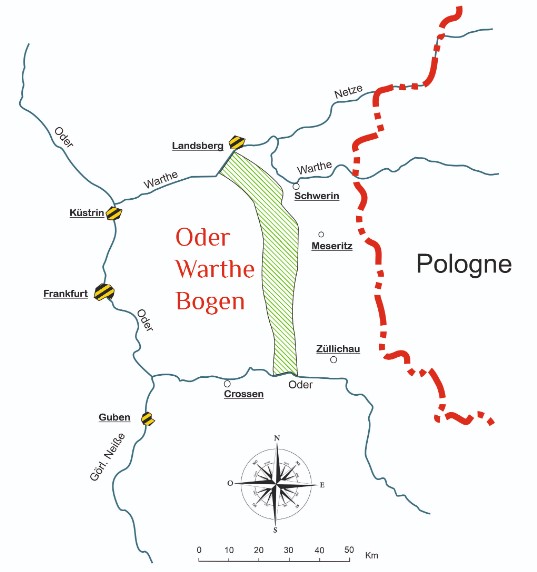
The remilitarization of Germany began as early as 1933. The fortifications department was recreated. The first projects were drawn up on the basis of pre-World War I constructions, lessons learned from the fighting in the First World War, the evolution of techniques and what the intelligence services provided as elements of the Maginot Line.
Protecting Berlin, the capital of the empire, from a Russian attack was a priority. The geography offered an ideal configuration 120 km east of Berlin and 30 km from the Polish border. The project began in 1934 and planned to fortify the area between the Warthe Rivers in the north and the Oder River in the south, using a small relief that towered a few metres above the land to the east. The total length was to reach 120 km.
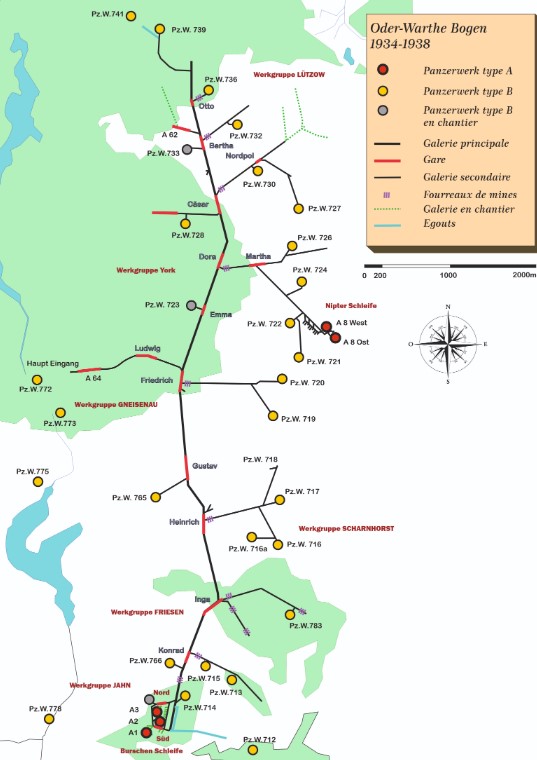
The central section will be built for a length of approximately 32 km.
The project included an impressive number of structures: :
- 15 type A Werke
- 13 type A1 sleaping A1 Werke
- 79 type B Werke
- 4 type A batteries
- In total 111 structures
Comparaison
Maginot line
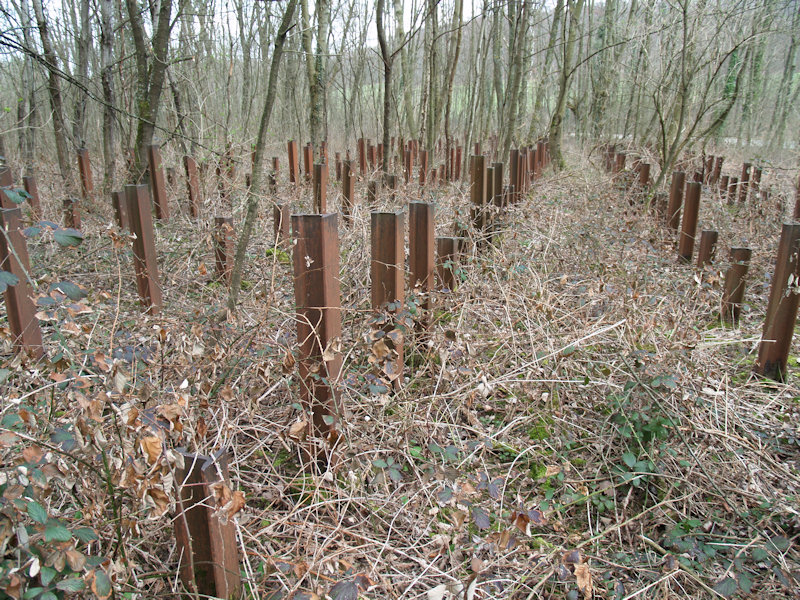
Oder-Warthe-Bogen
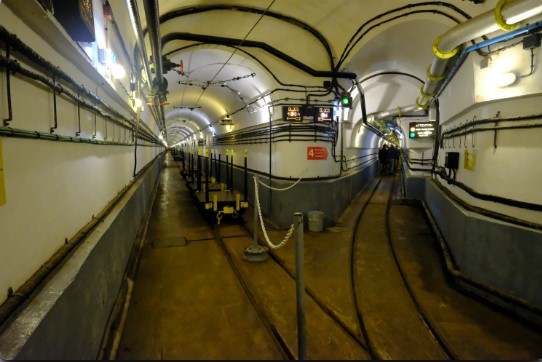
The galleries are built on a straight foot, the example of the German ovoid galleries has not been used. They made it possible to supply the combat blocks with ammunition, the men with food thanks to an electrically powered train from the rear areas where the main ammunition stores, the kitchens, the barracks, the hospital, etc. were located. The distance between the rear and the combat blocks varies from a few hundred meters to exceptionally 2 or 3 km depending on the topography of the area. This main gallery is always perpendicular to the defensive line
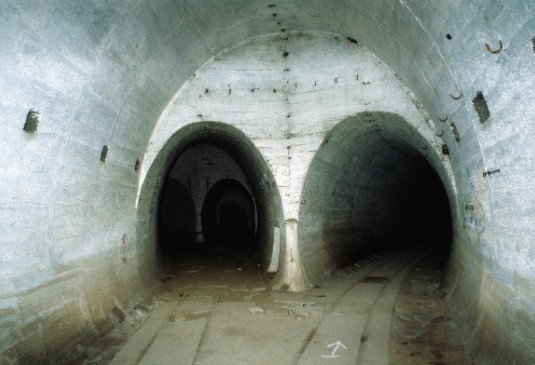
The connecting galleries, about thirty meters deep, are the heirs of the ovoid galleries of the German Festes (1910). Their dimensions vary according to the flows to be managed. Six profiles have been developed on this principle: the shelter profile with a height of 5 meters for 2 floors, the station profile with 4.20 meters, the main gallery profile with 3.55 meters, the 3 small profiles vary from 2.80 to 2.20 meters in height.
The main gallery is parallel to the defensive line, it connects 10 stations and is about 10 km long.
The battle blocks, batteries and entrances were connected to the stations by secondary galleries.The underground network represents approximately 23 km of galleries, all profiles combined.
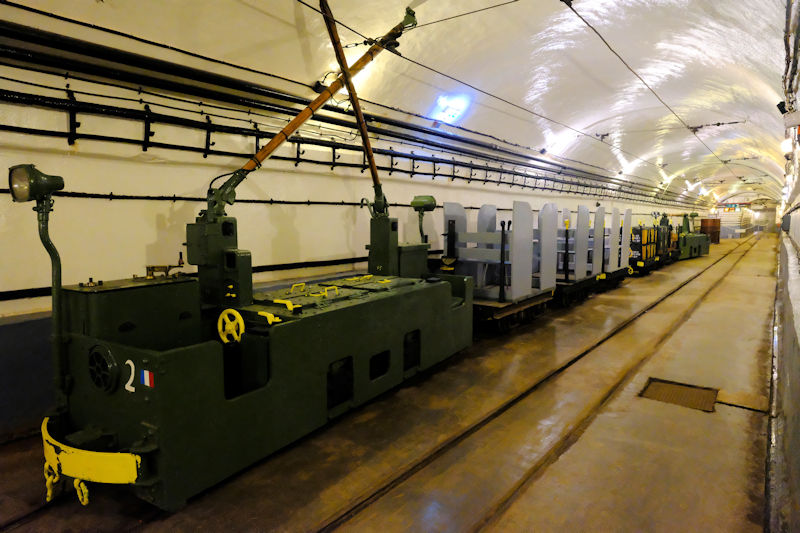
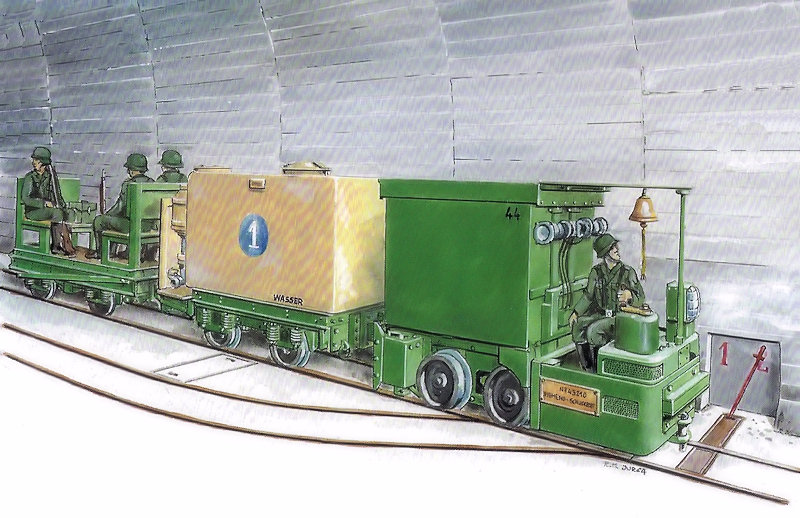
The trains of the Maginot Line are powered by a 600v catenary while the OWB trains run on batteries.
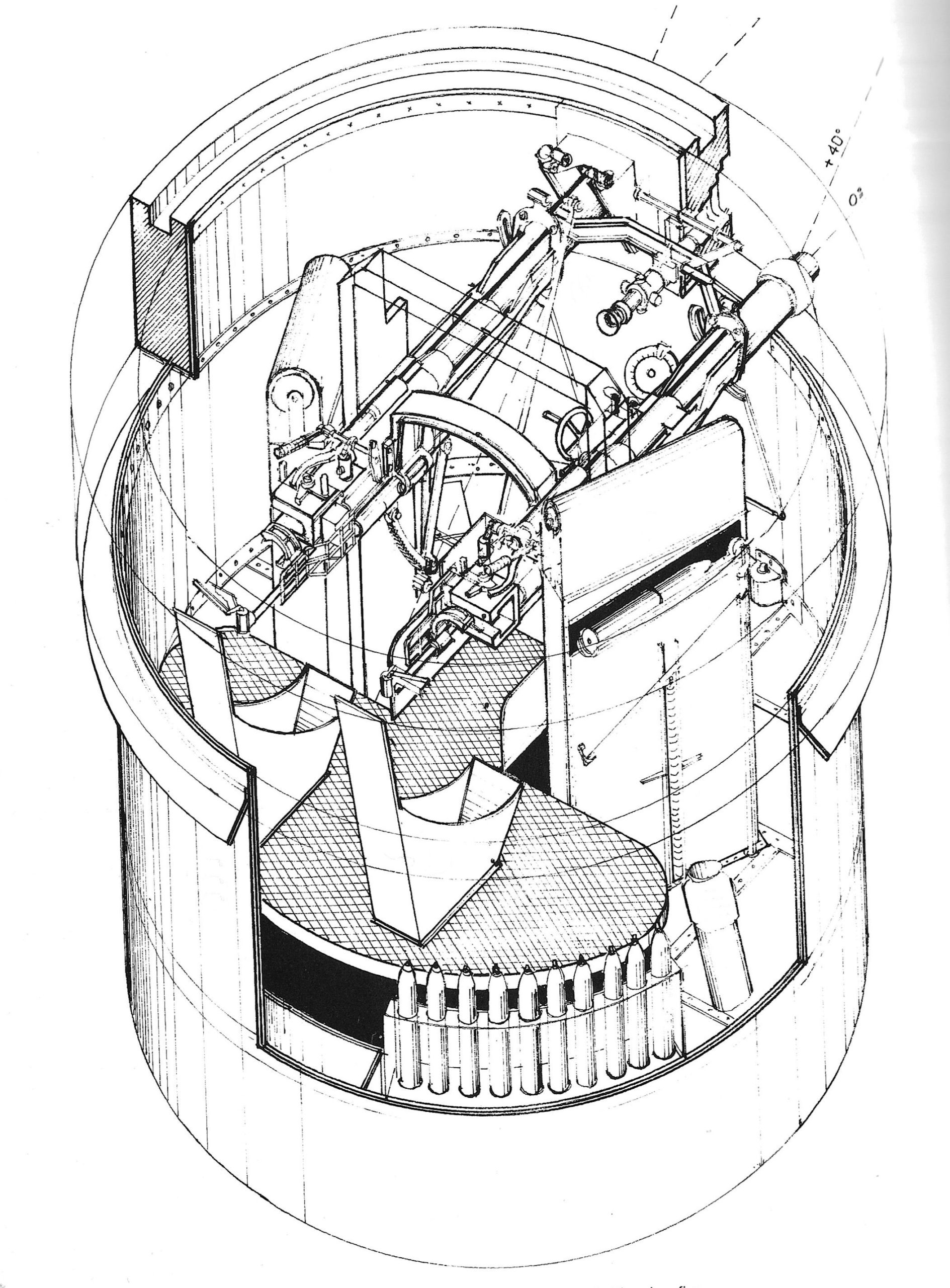
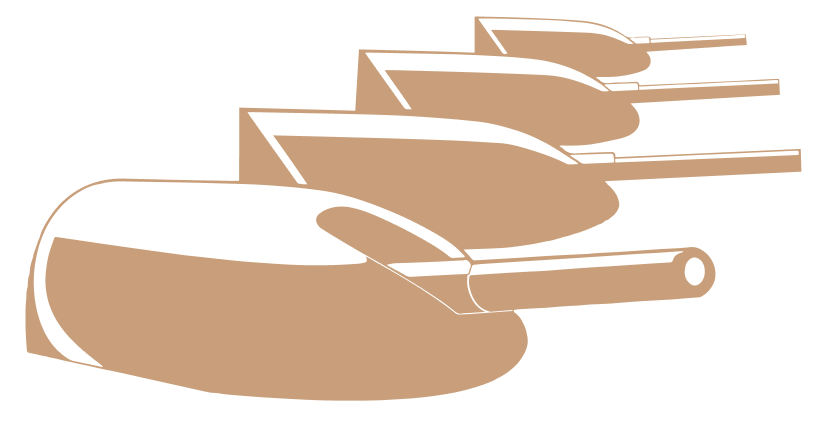
Characteristics of the 75/33 turret, the most modern of the Maginot Line:
- Total mass: 265 tons 2 semi-automatic loading guns
- Caliber: 75 mm
- Firing range : 12 km
- Rate of fire: 13 rounds/minute per gun
- Number of turrets installed: 21 (42 guns)
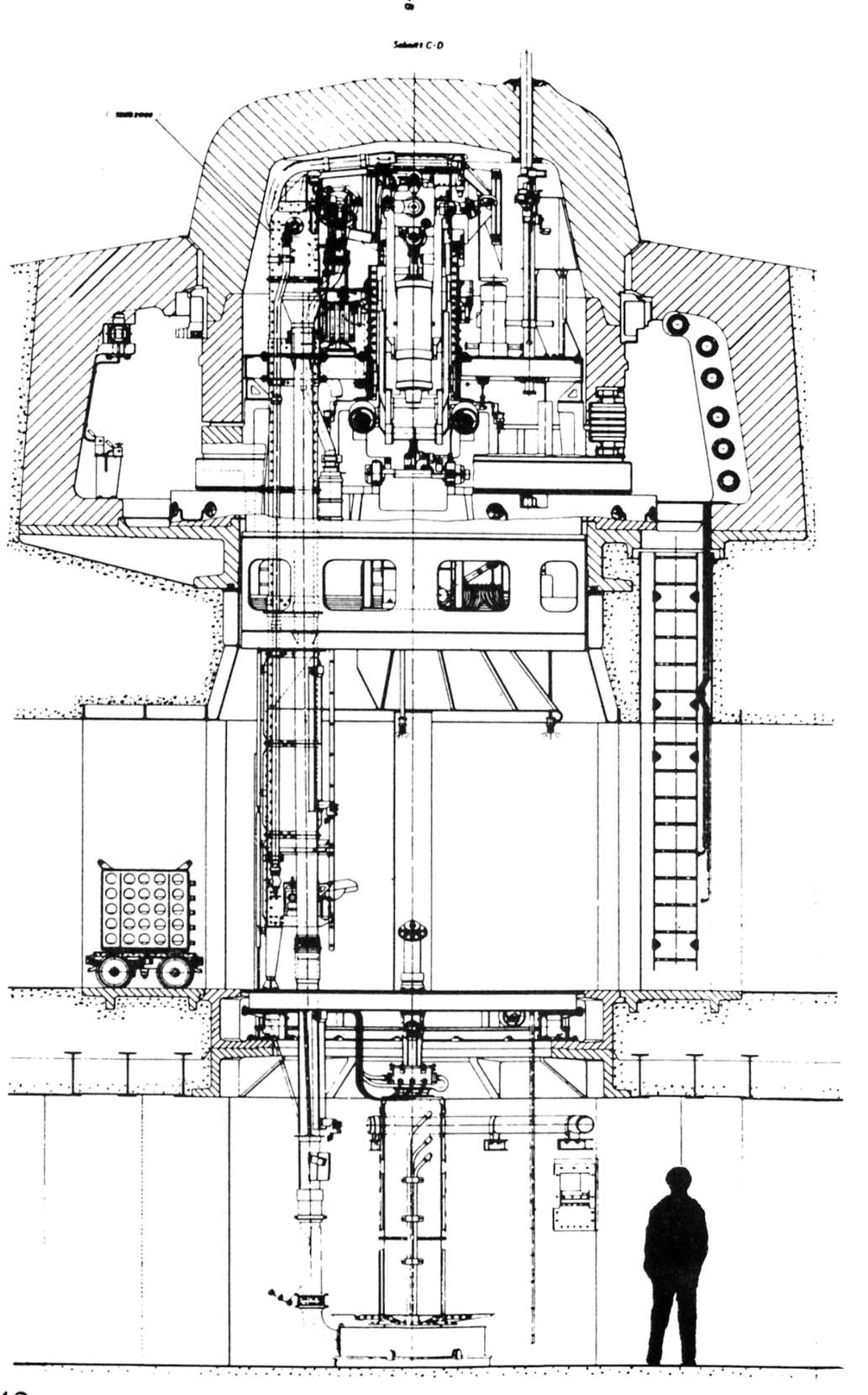
Theoretical characteristics of the 10cm turret, parts of which were delivered to the OWB site but which were not assembled: :
- Total mass: 470/670 tons
- Armor thickness: 600 mm
- 1 self-loading gun
- Caliber: 105 mm or 150
Final Analyse
Doubts about the suitability of the construction of the OWB have arisen within the army command. A study trip to the OWB site under construction was planned to assess the advantages and disadvantages of such a fortification. The Minister of War v Blomberg, Generals Keitel and Fromm, the Chief of the General Staff of the Army, the Inspector of Fortifications as well as Hitler himself took part in this inspection.
The trip was scheduled for October 30, 1935 with a special train for a 6-hour visit to the site. The work had been underway for 18 months, the works already built were under standard B and batteries to standard A were in the pipeline, already partially started, a part of the armour had already been delivered to the stations.
The project was initially approved by Hitler. The illusion that a fortified line benefiting from the latest available techniques and with a good capacity to resist modern artillery and aircraft can be designed and built without seriously impacting the ability to finance them within a reasonable time and not to be affected by technical obsolescence is present in both systems. The exaggeration of the German project “Oder Warthe Bogen” meant that the project was stopped after barely 2 years for multiple reasons. The defensive doctrine will become an offensive doctrine that favors mobile means, speed of movement and will eventually lead to the concept of Blitzkrieg. Strategy can no longer be based on a pure defensive concept.
The campaign of France and the uselessness of the Maginot Line will demonstrate this.
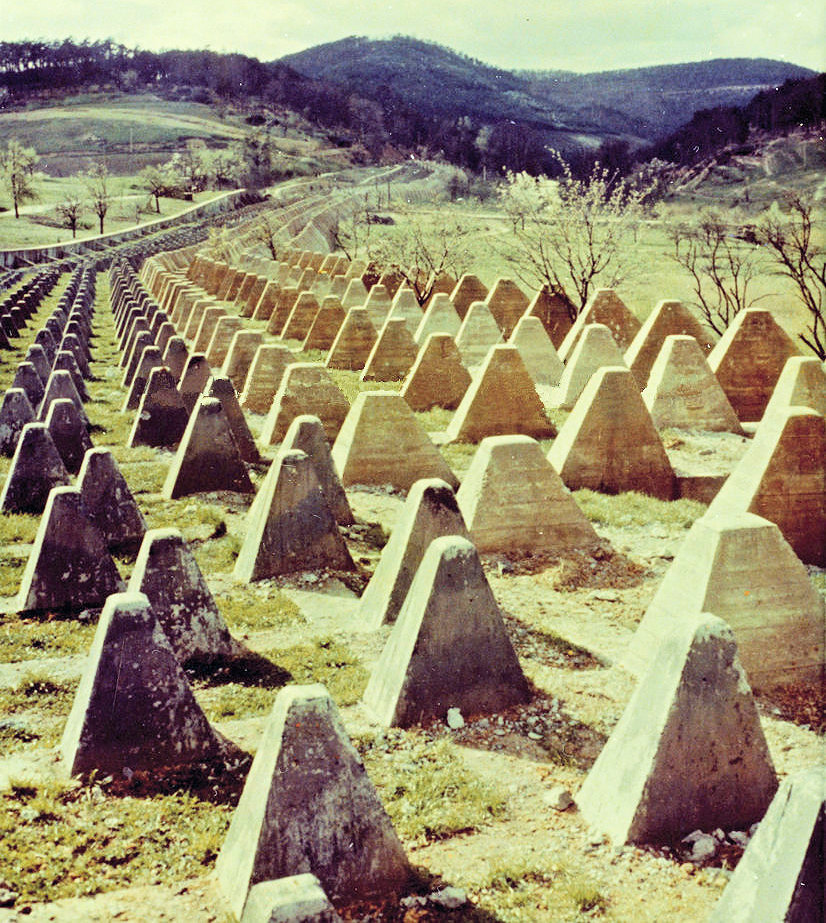
The Westwall
The project was quickly confronted with the very long lead times for the manufacture of the battleships, almost 15 years, the enormous construction costs and the evolution of the political situation in the East with the signing of the German-Soviet Pact on 23 August 1939 and the invasion of Poland. Hitler’s harsh criticism in July 1938 of the very concept of the OWB and the replacement of General Förster in November 1938 as head of the Inspection of Fortifications dealt a fatal blow to the fortification system of this type.
Completely anachronistic, these structures immobilize too many non-combatant troops and are equipped with specific armaments that cannot be moved.